Australia’s Most Accessible Beach program to return to Frankston
Published on 23 April 2026
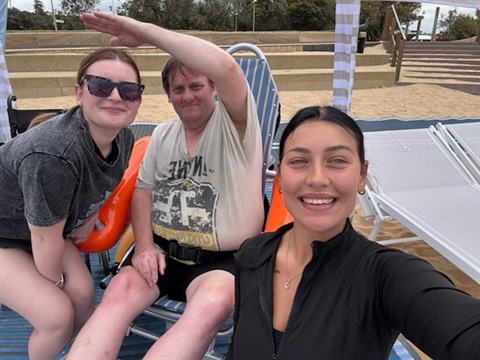
Frankston City Council is proud to announce that Australia’s Most Accessible Beach program will return for the 2026–2027 summer season, following unanimous endorsement at a Council meeting on 20 April. The extension reflects strong community demand and the impacts of last summer’s pilot program.
Across the 2025–2026 pilot, people who had spent years — sometimes decades — watching the ocean from afar were finally able to return to the sand. Some even touched the ocean water for the first time in their lives. Others wept as the tide washed over their legs after believing that moment would never come again.
Frankston City Council worked with Accessible Beaches Australia to bring the pilot to Frankston, with support from Surf Life Saving Victoria. Across three months (30.5 operational days), over 247 groups (more than 456 participants) took part in Australia’s Most Accessible Beach pilot. A further 241 community members made use of the accessible beach matting.
The pilot data tells a powerful story:
- 91.8% of participants said the Accessible Beach was the main reason they visited Frankston
- 29% said they had not been able to visit a beach for over 11 years
- Several reported it had been more than 20 years since they last touched the ocean
Behind every statistic was a person who had once been excluded from something most people take for granted.
Families travelled from across Victoria — one journeying two hours by maxi taxi — just so their daughter with a disability could experience her first ever ocean swim.
For many, these moments weren’t just exciting. They were life changing.
For Shane Joy, a Frankston local born and raised by the bay, this summer meant coming home.
Shane lives with a hereditary degenerative spinal disease. He has survived a broken neck. He has endured two strokes. And for 20 years, he could not safely get onto a beach.
Once an avid scuba diver, the ocean was part of his identity, until it suddenly became out of reach. Last summer changed that for him.
Shane visited Frankston’s Accessible Beach almost every weekend of the pilot’s operation, rolling across the matting and into the water for the first time in two decades.
“Being back in the sea... it’s a beautiful thing,” he said. “I used to love scuba diving. I never thought I’d feel the water around me again. But I can. And it’s made me feel better within myself.”
Shane says the return to the beach has reconnected him not only to the sea, but to his community.
“People with disabilities are often an afterthought. But this makes us feel like people care. Like we belong. Like we can enjoy the beach just like everyone else.”
He smiles when he talks about his weekends at the foreshore.
“I’ll tell anyone who’ll listen — this has been transformational. Not just for me, but for the others I’ve met down there,” he said. “Frankston really is leading the way in accessibility, and I hope that others follow.”
Councillor Nathan Butler said the impact of the program had been felt far beyond the shoreline.
“This program is about much more than access to the beach — it’s about belonging, dignity and feeling seen,” Cr Butler said. “When members of our community tell us they’re doing something they never thought they’d be able to do again, that’s when you know you’re delivering something truly meaningful.”
Frankston City Mayor Cr Sue Baker said the pilot underscored a simple but powerful truth: the beach should be a place for everyone — and that’s why Council was proud to secure the program’s continuation.
“This initiative reminded us that accessibility is ultimately about people and their experiences. It shows what can be achieved when inclusion is treated as a priority, not an afterthought.”
“The incredible response from the community made it clear this was something they didn’t want to lose. Council is delighted to have delivered a program that gave so many Victorians such a special summer — and just as delighted to confirm it will return next year.”
Shane Hryhorec, Founder and Chair of Accessible Beaches Australia said this is the most comprehensive beach accessibility initiative delivered by any local government in Australia to date.
“What has been created here in Frankston sets a new national standard for inclusive coastal design and genuine access for people with disability,” he said. “We will look back at the Frankston pilot as the moment this movement truly began, when a local council chose to lead, not follow.”
“This is not just about infrastructure. It is about dignity, independence and ensuring that everyone can experience the beach as it was always meant to be experienced.”
Many organisations provided financial and in-kind contributions that helped to bring the project to life, with over $200,000 raised locally. Council contributed $45,000, alongside additional in-kind support.
“Having 30 organisations* sponsor the pilot — collectively raising more than the total cost of the program — showed just how strongly the community backed this initiative,” Mayor Baker said.
“This program simply would not have been possible without our sponsors, including our major supporter the Social Inclusion Action Group (SIAG) Frankston. Their support helped turn access into action and ideas into life‑changing experiences.”
That strong backing from sponsors has resulted in surplus funds, which Council will now reinvest to deliver Australia’s Most Accessible Beach program again over the 2026–2027 summer season. Council support will continue to underpin the program, with operational dates to be confirmed closer to summer.
Momentum is already growing for the 2026–2027 season, with two additional sponsors** already confirmed to support the program.
Building on its commitment to accessibility, Council has also applied for $108,184 through the Commonwealth Accessible Australia Initiative to aid in the delivery of a new Changing Places facility at the Frankston Waterfront, as part of an upgrade estimated at around $280,000.
Changing Places facilities are specially designed, larger‑than‑standard public toilets that include features such as height‑adjustable adult change tables and ceiling track hoists, supporting people with complex disabilities and high support needs who cannot use standard accessible toilets.
A decision about the grant is expected by late April 2026. If successful, the new Changing Places facility would significantly expand who can access and use the foreshore, making Frankston Beach accessible to more people than ever before.
With the program’s future now secured, Frankston City Council is looking ahead to next summer — focused on continuing to remove barriers, expand access and deliver truly inclusive beach experiences for all Victorians.
For more information about the pilot: Australia's Most Accessible Beach Pilot - Frankston City Council
*2025–2026 pilot sponsors include:
Social Inclusion Action Group (SIAG) Frankston, Rotary Peninsula 2.0, Anaconda, Peninsula Leisure, Frankston RSL, Sandhurst Club, Monash University, Challenger Services Group /Nivad, Excel Australasia, The Dicker Family, The Australian Wuxi General Chamber of Commerce, MAAC Care, Seaford RSL, Frankston District Basketball Association, Grace Professional Services, Frankston District Netball Association, Signature Hospitality Group, Ecco Enterprises Group, Sinopec, South East Water, Bayside Shopping Centre / Vicinity, Ash Marton Realty, Rotary Club of Frankston, Rotary Club of Frankston Sunrise, Frankston North Rotary, Peninsula Health, Peninsula Rotaract, Chisholm TAFE Frankston, Frankston Business Chamber and Karingal Hub.
**Additional sponsors confirmed for 2026–2027:
Bunnings Group Ltd and Roccella Lido Pty Ltd.