Community Engagement
Our commitment to community engagement
Council commits to having a planned, visible and inclusive process for how we provide our community with opportunities to influence Council decisions that affect their lives.
The commitment includes:
- Undertaking early and thorough evidence-based engagement planning, including analysing pre-existing data, gender impact assessments and other demographic insights
- Tailoring the level of engagement to suit the needs of each project, from smaller neighbourhood-based to larger municipal-wide projects
- Clearly explaining what is in scope for each engagement project and the level of influence available to the community
- Using a variety of engagement and promotional methods, tailored to the needs of each project to increase visibility and participation
- Engaging in accessible ways that help us understand and include diverse views, experiences and expertise
- Genuinely listening and considering community feedback to ensure it can influence Council’s decisions and project outcomes
- Evaluating and reviewing engagement projects to ensure continuous improvement and innovation
What is community engagement?
Community engagement is based on the principle that people have a right to be involved in the decisions that affect their lives. To Council, this means we give every community member the opportunity to have a say in Council’s decisions.
As a local government organisation, everything Council does affects the people that live, work, and play in Frankston City. From big-picture planning to delivering programs and services, Council’s work is done on behalf of the community. However, community engagement means different things to different people. We explain what we exclude from our community engagement requirements in our Community Engagement Framework.
Engagement can take many forms - from Council simply sharing information to getting local people directly involved in making Council decisions, it’s about helping the community to influence decisions that affect Council services, strategies and plans. When our community are engaged, they should see how their contributions make a difference to a decision and to long term outcomes in their local neighbourhoods and wider municipality.
In community engagement, the term influence is key — it reflects how community input helps shape Council decisions, but it doesn’t mean the community makes the final call. Council uses the IAP2 Spectrum of Public Participation to outline five difference levels of influence, and how Council will apply these levels to each project and at various project stages. Learn more in our Community Engagement Framework(PDF, 3MB).
Community Engagement Principles
Council’s Community Engagement Policy sets the commitments, values and Community Engagement Principles that define Council’s approach to community engagement and which are consistent with the Act.
Council commits to complying with each of the principles in every community engagement project. If this is not possible, Council will instead opt to communicate or educate the community or undertake stakeholder engagement instead of community engagement.
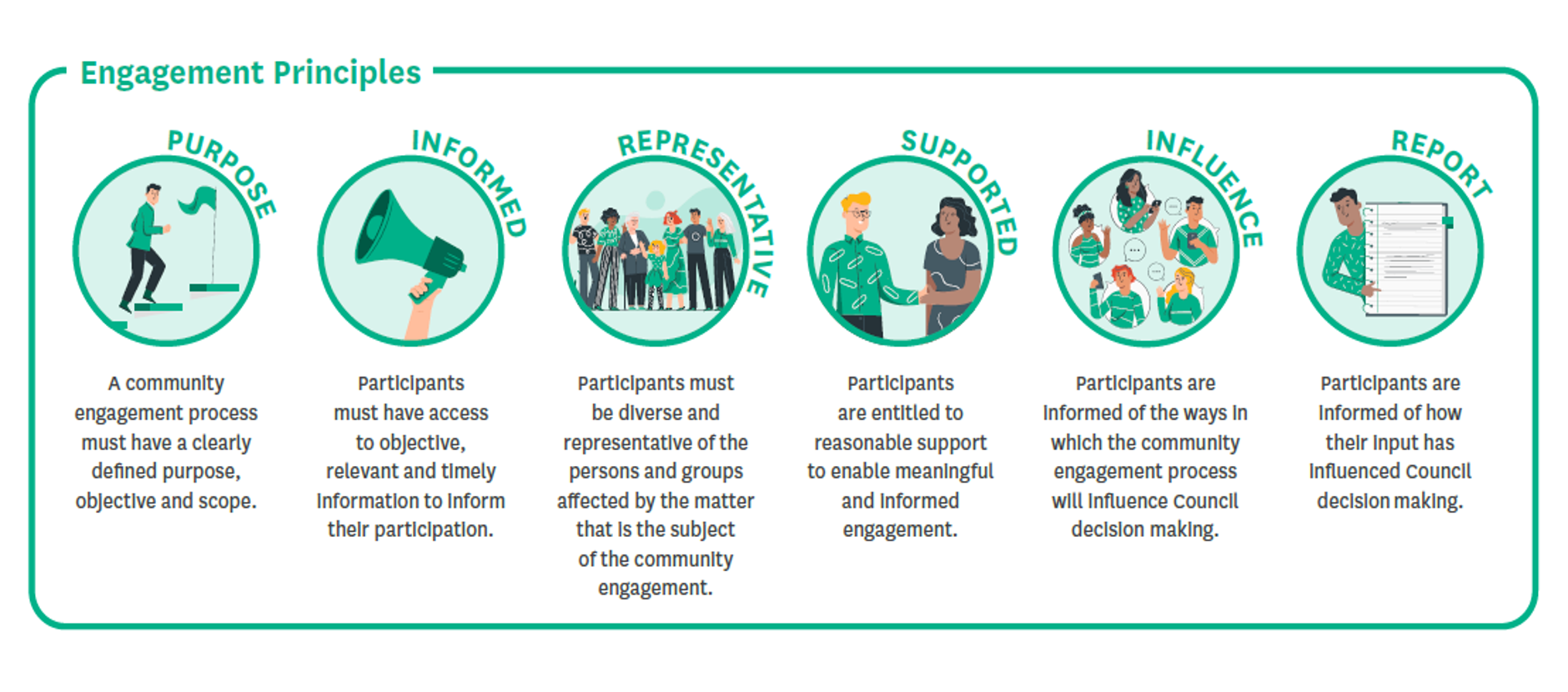
We have simplified the principles in our Community Engagement Framework to improve understanding and accessibility. The principles that guide how we deliver community engagement are:
- Purpose: We will clearly explain why we are asking for the community’s input and what is in and out of scope
- Influence: We will explain clearly how community input will be shared with Councillors to influence their decision; we will not ask for your input if there is no opportunity for influence (we will communicate or educate community instead)
- Representative: We will make our projects visible and accessible so that we receive the diverse input that Council needs to make decisions in the interest of our community
- Supported and informed: We will give you enough information and time for you to access and understand what you’re providing input on
- Report: We will keep you updated during our project stages, and explain what we heard from the community and how it was used by Council in making their decision